facebookresearch / ImageBind
ImageBind One Embedding Space to Bind Them All
AI Architecture Analysis
This repository is indexed by RepoMind. By analyzing facebookresearch/ImageBind in our AI interface, you can instantly generate complete architecture diagrams, visualize control flows, and perform automated security audits across the entire codebase.
Our Agentic Context Augmented Generation (Agentic CAG) engine loads full source files into context, avoiding the fragmentation of traditional RAG systems. Ask questions about the architecture, dependencies, or specific features to see it in action.
Embed this Badge
Showcase RepoMind's analysis directly in your repository's README.

Repository Summary (README)
PreviewImageBind: One Embedding Space To Bind Them All
Rohit Girdhar*, Alaaeldin El-Nouby*, Zhuang Liu, Mannat Singh, Kalyan Vasudev Alwala, Armand Joulin, Ishan Misra*
To appear at CVPR 2023 (Highlighted paper)
[Paper] [Blog] [Demo] [Supplementary Video] [BibTex]
PyTorch implementation and pretrained models for ImageBind. For details, see the paper: ImageBind: One Embedding Space To Bind Them All.
ImageBind learns a joint embedding across six different modalities - images, text, audio, depth, thermal, and IMU data. It enables novel emergent applications ‘out-of-the-box’ including cross-modal retrieval, composing modalities with arithmetic, cross-modal detection and generation.
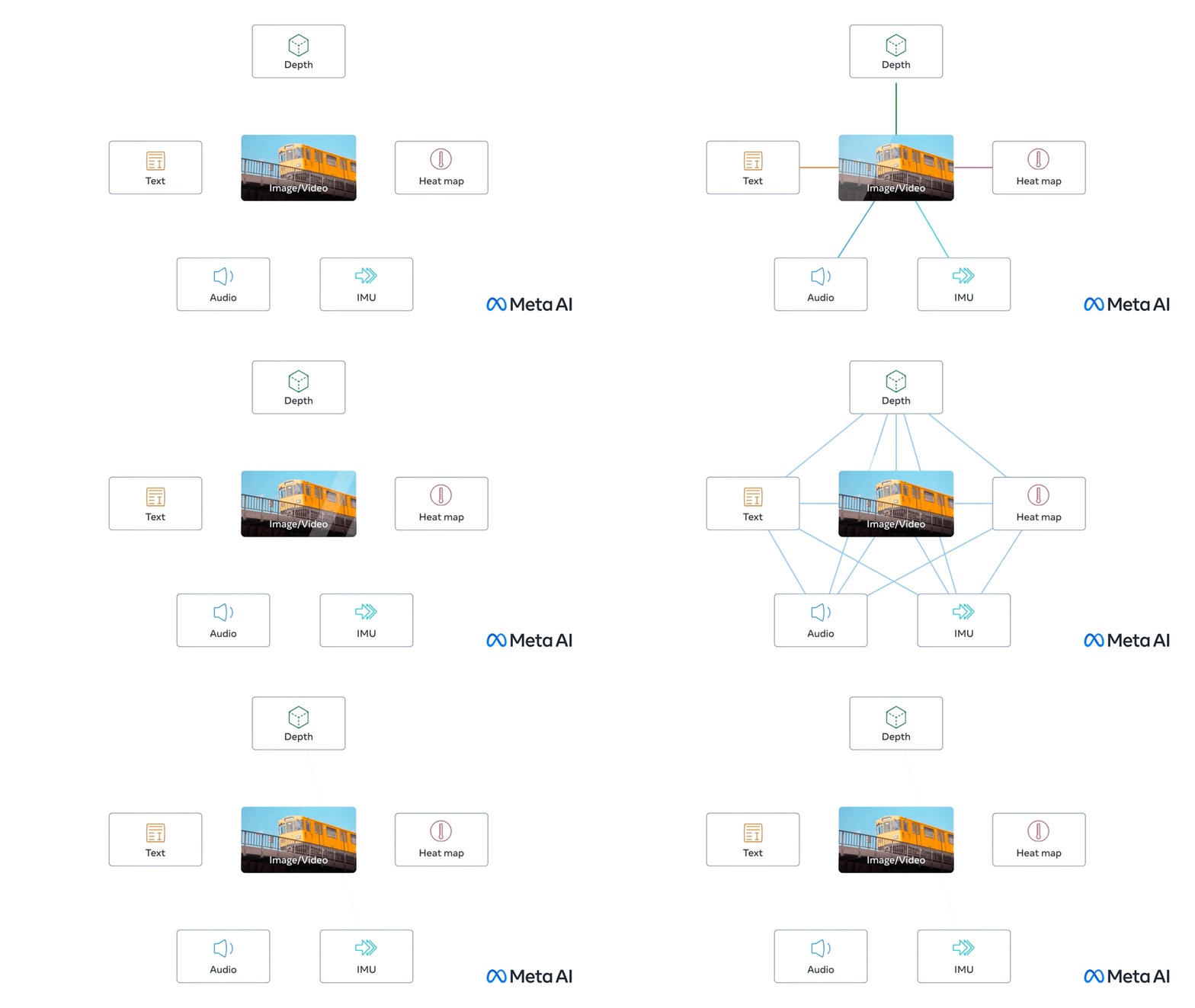
ImageBind model
Emergent zero-shot classification performance.
<table style="margin: auto"> <tr> <th>Model</th> <th><span style="color:blue">IN1k</span></th> <th><span style="color:purple">K400</span></th> <th><span style="color:green">NYU-D</span></th> <th><span style="color:LightBlue">ESC</span></th> <th><span style="color:orange">LLVIP</span></th> <th><span style="color:purple">Ego4D</span></th> <th>download</th> </tr> <tr> <td>imagebind_huge</td> <td align="right">77.7</td> <td align="right">50.0</td> <td align="right">54.0</td> <td align="right">66.9</td> <td align="right">63.4</td> <td align="right">25.0</td> <td><a href="https://dl.fbaipublicfiles.com/imagebind/imagebind_huge.pth">checkpoint</a></td> </tr> </table>Usage
Install pytorch 2.0+ and other 3rd party dependencies.
conda create --name imagebind python=3.10 -y
conda activate imagebind

pip install .
For windows users, you might need to install soundfile for reading/writing audio files. (Thanks @congyue1977)
pip install soundfile
Extract and compare features across modalities (e.g. Image, Text and Audio).
from imagebind import data
import torch
from imagebind.models import imagebind_model
from imagebind.models.imagebind_model import ModalityType

text_list=["A dog.", "A car", "A bird"]
image_paths=[".assets/dog_image.jpg", ".assets/car_image.jpg", ".assets/bird_image.jpg"]
audio_paths=[".assets/dog_audio.wav", ".assets/car_audio.wav", ".assets/bird_audio.wav"]

device = "cuda:0" if torch.cuda.is_available() else "cpu"

# Instantiate model
model = imagebind_model.imagebind_huge(pretrained=True)
model.eval()
model.to(device)

# Load data
inputs = {
    ModalityType.TEXT: data.load_and_transform_text(text_list, device),
    ModalityType.VISION: data.load_and_transform_vision_data(image_paths, device),
    ModalityType.AUDIO: data.load_and_transform_audio_data(audio_paths, device),
}

with torch.no_grad():
    embeddings = model(inputs)

print(
    "Vision x Text: ",
    torch.softmax(embeddings[ModalityType.VISION] @ embeddings[ModalityType.TEXT].T, dim=-1),
)
print(
    "Audio x Text: ",
    torch.softmax(embeddings[ModalityType.AUDIO] @ embeddings[ModalityType.TEXT].T, dim=-1),
)
print(
    "Vision x Audio: ",
    torch.softmax(embeddings[ModalityType.VISION] @ embeddings[ModalityType.AUDIO].T, dim=-1),
)

# Expected output:
#
# Vision x Text:
# tensor([[9.9761e-01, 2.3694e-03, 1.8612e-05],
#         [3.3836e-05, 9.9994e-01, 2.4118e-05],
#         [4.7997e-05, 1.3496e-02, 9.8646e-01]])
#
# Audio x Text:
# tensor([[1., 0., 0.],
#         [0., 1., 0.],
#         [0., 0., 1.]])
#
# Vision x Audio:
# tensor([[0.8070, 0.1088, 0.0842],
#         [0.1036, 0.7884, 0.1079],
#         [0.0018, 0.0022, 0.9960]])
Model card
Please see the model card for details.
License
ImageBind code and model weights are released under the CC-BY-NC 4.0 license. See LICENSE for additional details.
Contributing
See contributing and the code of conduct.
Citing ImageBind
If you find this repository useful, please consider giving a star :star: and citation
@inproceedings{girdhar2023imagebind,
  title={ImageBind: One Embedding Space To Bind Them All},
  author={Girdhar, Rohit and El-Nouby, Alaaeldin and Liu, Zhuang
and Singh, Mannat and Alwala, Kalyan Vasudev and Joulin, Armand and Misra, Ishan},
  booktitle={CVPR},
  year={2023}
}